• Home
  • Suggest A DIY
  • DIY Newsletter

Lesson Plans

Ideas and resources

  • About CraftGossip
  • Our Network
    • Bath & Body Crafts
    • Candle Making Ideas
    • Crochet Ideas
    • Cross Stitch
    • Edible Crafts
    • Felting Patterns
    • Glass Art
    • Home & Garden Ideas
    • Indie Crafts
    • Jewelry Making
    • Kids Crafts
    • Knitting Patterns
    • Lesson Plans
    • Needlework
    • Party Ideas
    • Polymer Clay
    • Quilting Ideas
    • Recycled Crafts
    • Scrapbooking
    • Sewing Patterns
    • Card Making
    • DIY Weddings
    • Not Craft Ideas
  • Giveaways
  • Roundups
  • Store
  • Search

All About Antarctica for Kids

January 11, 2024 by Sarah White Leave a Comment

Antarctica is technically a continent, not a country, but I couldn’t resist throwing it in here (especially since it’s winter in the Northern Hemisphere). On average it’s the coldest, driest and windiest continent, and of course the least inhabited, with only a few thousand people living there at any given time.

Antarctica Basics

Antarctica is the fifth-largest continent and is 40 percent larger than Europe. The land area is around 14,200,000 square kilometers, or 5,500,000 square miles, and most of the land is covered with an ice sheet that’s 1.2 miles/1.9 km deep.

The Antarctic Treaty of 1957 established the continent as a scientific preserve, and nations that do significant research there have a collective say in decision making. Seven different countries claim sovereignty over parts of Antarctica, including Argentina, Australia, Chile, France, Great Britain, New Zealand and Norway.

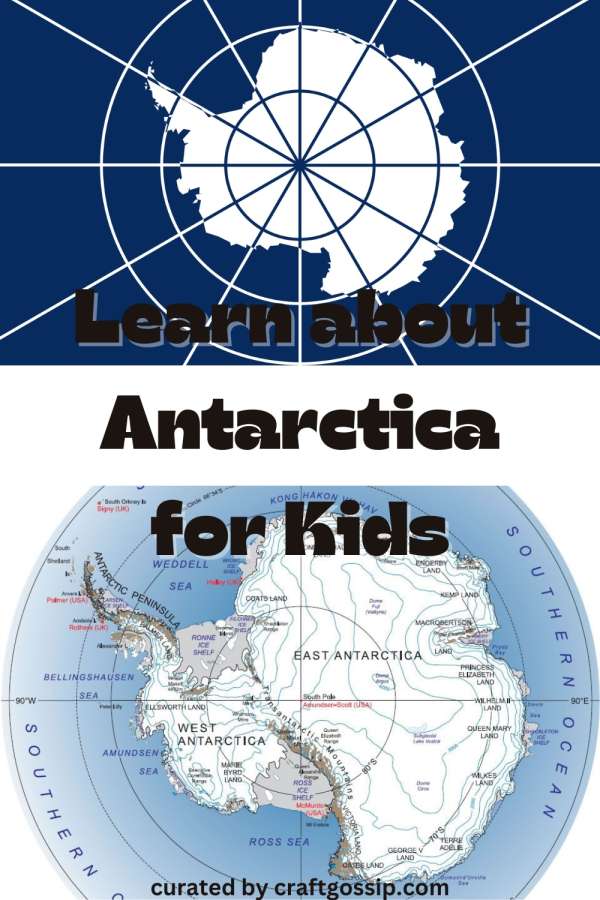
The land surrounds the South Pole and is almost all below the Antarctic Circle. It’s divided into eastern and western sections separated by the Transantarctic Mountains. Most of the land is a polar desert and it only receives about 6 inches/150 mm or precipitation (mostly as snow) every year.

Antarctica Symbols

Because Antarctica isn’t actually a country it doesn’t have an official flag or national anthem or anything. The emblem of the Antarctic Treaty is sometimes used as a flag (and is shown above).

So how about some fun facts instead? Antarctica is home to penguins and seals, as well a mites, nematodes and tardigrades. What vegetation occurs is mostly lichen and moss.

About 70 percent of the world’s fresh water is frozen in Antarctica, and if it melted would raise sea levels by almost 60 meters/200 feet (thanks Wikipedia!).

The lowest natural air temperature ever recorded was at the Russian Vostok Station on July 21, 1983, and was −89.2 °C (−128.6 °F).

Antarctica Activities for Kids

NASA has a good article about Antarctica for kids and what NASA learns about the earth and about space from studying the continent.

Antarctica Day is apparently December 1 (it celebrates the signing of the treaty in 1959 mentioned above), and you can read more about its importance and the kind of work being done there in this article from the National Science Foundation.

Trillium Montessori has a great set of printable cards on the physical features of Antarctica, including icebergs, glaciers and the South Pole. 

Homeschooling My Kinetic Kids has printable cards on different animals that live in and around Antarctica, based on the Antarctic animals Toob toys. You can also make an Antarctica shelf for kids to explore with these ideas from Pinay Homeschooler.

Make fun origami penguins with this craft from Artsy Craftsy Mom.

Antarctica Books for Kids

Learn more about Antarctica with books like these:

  • Where is Antarctica?
  • A Kids Guide to Antarctica
  • Antarctica: A Continent of Wonder
  • The Frozen Worlds: The Astonishing Nature of the Arctic and the Antarctic

Next Plan Idea:

  • Activities to Honor Waitangi Day
«
»

Have you read?

Book Review: Wild Your World

Most kids go through a phase where they want to learn more about animals, and it’s fun for them to learn about the diversity of the natural world and what humans can do to protect other creatures we share the planet with. Camilla de la Bedoyere has written a couple of books, illustrated by Philip Giordano, to help kids learn more about birds and bees. 

Wild Your World: Birds looks at many different kinds of birds that live around the world and covers things like parts of a bird, different habitats that birds live in, migration, camouflage, what and how birds eat and more. 

With lovely illustrations showing a diverse array of birds found around the world, the book talks about different birds that live in the woodlands, rainforest, fields and farms, coastland, grasslands and deserts, urban areas and the polar regions. 

It talks about some of the biggest, smallest and fastest birds, and fun facts about different birds. For example you’ll learn about birds that next in cacti, the birds with weird shaped eggs so they won’t roll off cliffs, and meet the birds that migrate from New Zealand to Alaska. 

Wild Your World: Bees follows a similar format, talking about different kinds of bees (and how the vast majority of bee species are solitary bees), parts of a bee and why bees look the way they do, how bees collect nectar and pollen, how bees sense the world around them, how their wings work and what life in a colony is like. 

It covers the bee life cycle, how bees make honey, what causes a swarm and more. It covers digger bees, carpenter bees, orchid bees, cuckoo bees (who lay their eggs in the nests of teddy bear bees so they don’t have to take care of their young), mining bees, plasterer bees, leaf-cutter, wool carder and mason bees (so named because they collect materials to make their nests), bumblebees and swaet bees.

Readers will also learn about keeping bees. Both books talk about the dangers to birds and bees and what humans can do to help them. 

These books are aimed at readers ages 4-9 who will enjoy looking at the pictures and learning about these animals and how people can help protect them. 

About the books: Both books are 46 pages and hardcover. Published 2025 by Design Eye (see: birds|bees). Both books retail for $16.99. 

Let’s Get Buzzing About World Bee Day

Bee Craft – Learning about Pollination

Learning about Bees for Kids

Leave a Reply

Your email address will not be published. Required fields are marked *

Categories

Art Christmas Classroom Craft by Holiday Craft Inspirations DIY Tutorials and Patterns Elementary Games General Homeschool Kids Crafts Lesson Plan Activities & Ideas Math Nature PreSchool Printables Science Craft STEM & STEAM Toddler Tween

RSS More Articles

  • Samplers to Cross Stitch for the Fourth of July
  • Teach the Teacher Activities and Lesson Plans That Put Students in Charge
  • DIY Flag Banner for 4th of July Decorating
  • Vintage Baby Sweater Knitting Pattern PDF – Baby Cardigan and Crew Neck Jumper
  • 12 Cards with the Colors of the Rainbow
  • 15 Dog Poop Bag Carriers You Can Sew For Your Dog
  • America 250 Fourth of July Activities for Kids
  • Patriotic Knitting Patterns to Celebrate America’s Birthday
  • How To Refresh An Old Cracked Ceramic Duck Garden Ornament
  • Patriotic Quilted Placemats – A Festive Table Project for Summer Sewing

Pick Your Blog

  • Sewing
  • Knitting
  • Quilting
  • Crochet
  • Home & Garden
  • Recycled Crafts
  • Scrapbooking
  • Card Making
  • Polymer Clay
  • Cross-Stitch
  • Edible Crafts
  • Felting
  • Glass Art
  • Indie Crafts
  • Kids Crafts
  • Jewelry Making
  • Lesson Plans
  • Needlework
  • Bath & Body
  • Party Ideas
  • Candle Making
  • DIY Weddings
  • Not Craft
  • Free Craft Projects

Copyright © 2026 · CraftGossip | Start Here | Contact Us | Link to Us | Your Editors | Privacy and affiliate policy