• Home
  • Suggest A DIY
  • DIY Newsletter

Lesson Plans

Ideas and resources

  • About CraftGossip
  • Our Network
    • Bath & Body Crafts
    • Candle Making Ideas
    • Crochet Ideas
    • Cross Stitch
    • Edible Crafts
    • Felting Patterns
    • Glass Art
    • Home & Garden Ideas
    • Indie Crafts
    • Jewelry Making
    • Kids Crafts
    • Knitting Patterns
    • Lesson Plans
    • Needlework
    • Party Ideas
    • Polymer Clay
    • Quilting Ideas
    • Recycled Crafts
    • Scrapbooking
    • Sewing Patterns
    • Card Making
    • DIY Weddings
    • Not Craft Ideas
  • Giveaways
  • Roundups
  • Store
  • Search

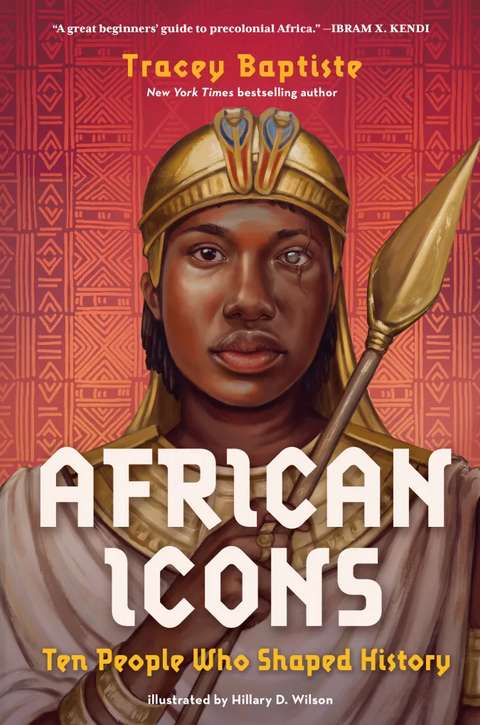
Book Review: African Icons

January 17, 2024 by Sarah White Leave a Comment

It’s a terrible thing that Black History Month so often focuses on the period of slavery onward, as if there was nothing of note happening in Africa during this time or indeed throughout the course of history before colonization.

I know when I was in school we learned about ancient Egypt, but that was about all the African history we learned. Of course there is so much more to know and so many historical figures from all over Africa that we should all spend more time learning about.

African Icons: Ten People Who Shaped History by Tracey Baptiste introduces young readers (and perhaps their teachers/parents) to 10 important Africans they might not have heard of before.

The list includes:

  • Menes, the first pharaoh of a united Egypt
  • Merneith, who led the country after her brother’s death and was nearly erased from history
  • Imhotep, the son of an architect who became a doctor and chief advisor to a pharaoh, and venerated as a god after his death
  • Aesop, the famous fable writer, who was likely Ethiopian and whose moralistic tales have been passed down for centuries
  • Hannibal Barca, the general and military strategist who waged war with Rome
  • Terence, a north African playwright enslaved in Rome, who was freed and educated by a Roman senator who saw what a good storyteller he was
  • Amanirenas, queen of Kush who battled Rome after they conquered Egypt
  • Tin Hinan, a leader of a nomadic group who led her people who establish a permanent community in the Sahara Desert (and whose story was considered a legend until her grave was found in 1925)
  • Mansa Musa, a ruler of Mali who expanded the wealth and size of his nation and is considered the richest person ever to have lived
  • Queen Idia, who ruled beside her husband in Benin, then raised an army to ensure her favored son would become king after his father’s death

Woven around these stories are essays about the history of Africa more generally, the importance of storytellers and books, and the history and culture that was lost through colonization and enslavement.

These stories would be great to share in a middle school/junior high classroom (they’re all pretty quick reads) as you learn more about African history, or to read at home as a family. These stories are the heritage of Black people everywhere and it’s important for all of us to know more about it.

About the book: 176 pages, paperback. Published 2021 (paperback edition 2024) by Algonquin Young Readers. Suggested retail price $9.99 paper/$14.99 hardcover
«
»

Have you read?

Learning about Georgia for Kids

Georgia is a state in the United States, of course, but Georgia is also the name of a country that was formerly part of the Soviet Union and now is considered part of Europe. Let’s learn more about the country of Georgia. 

Georgia Basics

Georgia is situated on the Black Sea and bordered by Russia, Turkey, Armenia and Azerbaijan. It is home to almost 4 million people, most of whom live in the capital, Tbilisi. 

The country is 26,900 square miles, or 69,700 square kilometers. 

People have lived in the area now known as Georgia since prehistoric times. It requested support from Russia to defend against hostile neighbors in the early 1800s, which led to Russia slowly annexing their land. Though they were briefly free after the Russian Revolution, the country was part of the Soviet Union until 1991. Russia invaded Georgia in 2008 and still occupies regions of the country.

The word Georgia referring to the region was first seen on an Italian map in 1320, but there’s a lot of debate as to where the word came from.

The majority of people living in Georgia today are Georgians, and they speak Georgian, an indigenous language that is apparently unrelated to any other language family in the world. Most people there practice Georgian Orthodox Christianity. 

Georgia is a representative democracy with a president and prime minister, as well as a parliament. 

Georgia National Symbols

The Georgian flag has a white background with a large red cross and a smaller red cross in each quadrant made by the big cross. It’s also known as the Five Cross Flag and was a symbol of the Kingdom of Georgia that was repopularized in the late 20th century, though it didn’t become the official national flag until 2004. 

The national anthem is “Tavisupleba” or “Freedom,” which was also approved in 2004. The music was adapted from two Georgian operas. 

The coat of arms features a lion on each side of a shield with an image of St. George, with a crown above that. The ribbon includes the national motto, which, translated to English, is “Strength is in unity.”

St George is the patron saint of Georgia. (Check out crafts and activities for St. George’s Day.)

Georgia Learning Activities

Twinkl has more about the history of Georgia and facts about the country. 

Learn about the giant head sculptures of Sno in this post form Atlas Obscura. They also have a good post about Prometheus Cave, which locals claim is where Prometheus was chained as punishment for stealing fire from the gods. 

Check out the giant plane tree in Telavi, an ancient tree that stands 150 feet (or 46 meters) tall and is the largest tree in Georgia.

This one is for the parents, but you might want to learn more about the history of wine making in Georgia, which is considered the birthplace of wine making. Evidence of grapes and grape seeds in the region dates back to 6000 BCE.

Georgia is so proud of its wine making history the the famous Mother of Georgia statue in Tbilisi holds a sword in one hand and a cup of wine in the other.

Check out this tour of Tbilisi from a local. 

It’s a little tricky to search for Georgia specific activities and get the nation, not the state, but this list from Teachers Pay Teachers is pretty good after the first one. 

Khachapuri, a Georgian cheese bread, is a popular dish that kids should love. Try this recipe from the Kitchn.

Leave a Reply

Your email address will not be published. Required fields are marked *

Categories

Art Christmas Classroom Craft by Holiday Craft Inspirations DIY Tutorials and Patterns Elementary Games General Homeschool Kids Crafts Lesson Plan Activities & Ideas Math Nature PreSchool Printables Science Craft STEM & STEAM Toddler Tween

RSS More Articles

  • 4 Crayon Cutable or Printable Files for Back to School
  • How to Make a Crochet Vision Board – Plan the Crochet Projects You Actually Want to Make
  • What to Serve with Rotisserie Chicken: 21 Delicious Sides You’ll Want on Repeat
  • Etsy Feature – Moth Pottery Template for Slab Building
  • Hubcap Creatures: Transforming Roadside Finds into Sculptural Wildlife
  • Learning about Georgia for Kids
  • How to Make a Moth Birthday Card
  • DIY Giant Eyeball Lanterns – Creepy Halloween Decoration
  • Designer Spotlight: Artmishka Cross Stitch
  • Freebie Friday – Grungy Pumpkins and Fall Tags Junk Journal Printables

Pick Your Blog

  • Sewing
  • Knitting
  • Quilting
  • Crochet
  • Home & Garden
  • Recycled Crafts
  • Scrapbooking
  • Card Making
  • Polymer Clay
  • Cross-Stitch
  • Edible Crafts
  • Felting
  • Glass Art
  • Indie Crafts
  • Kids Crafts
  • Jewelry Making
  • Lesson Plans
  • Needlework
  • Bath & Body
  • Party Ideas
  • Candle Making
  • DIY Weddings
  • Not Craft
  • Free Craft Projects

Copyright © 2026 · CraftGossip | Start Here | Contact Us | Link to Us | Your Editors | Privacy and affiliate policy