• Home
  • Suggest A DIY
  • DIY Newsletter

Lesson Plans

Ideas and resources

  • About CraftGossip
  • Our Network
    • Bath & Body Crafts
    • Candle Making Ideas
    • Crochet Ideas
    • Cross Stitch
    • Edible Crafts
    • Felting Patterns
    • Glass Art
    • Home & Garden Ideas
    • Indie Crafts
    • Jewelry Making
    • Kids Crafts
    • Knitting Patterns
    • Lesson Plans
    • Needlework
    • Party Ideas
    • Polymer Clay
    • Quilting Ideas
    • Recycled Crafts
    • Scrapbooking
    • Sewing Patterns
    • Card Making
    • DIY Weddings
    • Not Craft Ideas
  • Giveaways
  • Roundups
  • Store
  • Search

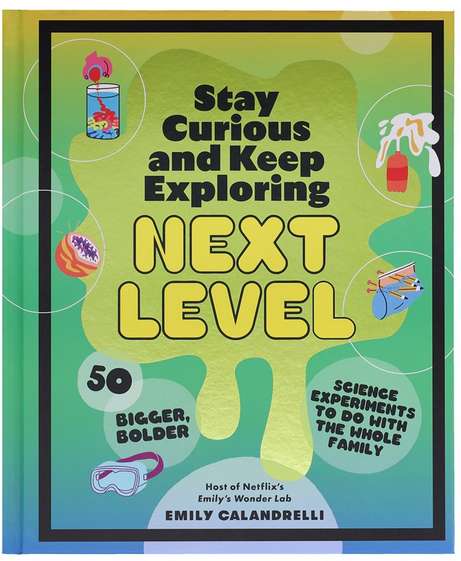
Book Review: Stay Curious and Keep Exploring (x2)

May 3, 2024 by Sarah White Leave a Comment

I grew up with Mr. Wizard as my science icon on TV, and I still have a copy of his Supermarket Science book (my daughter was completely unimpressed).

Emily Calandrelli may be this generation’s Mr. Wizard. She an MIT engineer and host of Emily’s Wonder Lab and Xploration Outer Space, as well as the author of two books full of science experiments kids can do at home, mostly with items you might already have in the house.

Stay Curious and Keep Exploring (published 2022, 168 pages, hardcover, 50 experiments, suggested retail price $22.95) features 50 projects on various themes: our of this world science, spooky science, things that glow, egg science, birthday science creations, magic tricks, kitchen science, experiments with a high potential to get messy. physics projects and ice experiments.

A few examples: magnetic slime, melting foam with acetone, making glow in the dark paint, bouncing  rainbow eggs, LED birthday cards, a self-filling balloon, a cookie baking experiment, horse toothpaste and broomstick balancing. These silly sounding projects are often tied to real-world lessons about how things work, such as why is it so hard to get ketchup out of a bottle, why do our fingers get wrinkly in the bath, and why does it take so long for water to boil.

Kids are encouraged to ask questions, make hypotheses and take notes in the book as they learn.

In addition to the experiments there are mini profiles of women is STEM through history, fun facts and ideas for changing up the experiments. There are also reference tables and a glossary in the back for any terms you don’t know.

The second book, Stay Curious and Keep Exploring Next Level (published 2024, 176 pages, hardcover, 50 experiments, suggested retail price $22.95) continues on the theme with bigger, bolder, messier projects in superhero science, scary science, bubbles, water, outdoor experiments, things that glow, science to do with friends, food science, science in color and projects related to the human body.

Here you’ll find fun projects like floating coins, zombie ping-pong balls, unpoppable bubbles, sticky water, egg geodes, exploding soda, secret notes, and how to extract strawberry DNA, among other things.

This book also includes profiles of people in STEM you’ll want to know and a glossary, but this one also has a shopping list to make stocking your science experiment pantry that much easier.

Either or both of these books would be great to gift to a curious kiddo or their parents (or grandparents!) who want to do some fun and messy learning with their kiddos.
«
»

Have you read?

Learning about Gabon for Kids

Gabon is a country in central Africa on the Equator, which is bordered by Equatorial Guinea, Cameroon and the Republic of the Congo, as well as the Atlantic Ocean and the Gulf of Guinea. Let’s learn more. 

Gabon Facts

Gabon has an area of 100,000 square miles, or 270,000 square kilometers and is home to about 2.3 million people. The capital and largest city is Libreville. Almost 90 percent of the land of Gabon is forest, and the nation has huge biodiversity.

The original inhabitants of Gabon were Bambenga, and the Kingdom of Orungu was established there in the 1700s, and France colonized the area in the later 19th century. Gabon gained its independence in 1960. 

The official language is French and about 95 percent of the population is part of the Bantu ethnic groups. The majority of people are Christian.

Gabon comes from the Portuguese word gabao, which means hooded cloak. Portuguese explorers in the 1470s used the term to refer to the Komo river estuary, which they said resembled a cloak. Eventually the name spread to cover the whole region. 

Gabon is a presidential republic with a legislature, though there have been many disputed elections and, in 2023, a military coup.

Gabon National Symbols

The Gabon flag consists of three horizontal stripes, in green, yellow and blue. The flag was adopted in 1960.

The national anthem is “La Concorde,” and it was written and adopted in 1960 as well.

The coat of arms features a ship on a shield with the same colors as the flag, with three yellow circles in the green section. Above the crest is a large tree, and the crest is flanked by black panthers. The motto, which translated to English is “unity, work, justice,” is below the shield, among the roots of the tree.  The slogan that translates to “we shall go forward together” hang around the tree. 

I couldn’t find any official national animals or plants, but black panthers are considered a national symbol because of their use on the coat of arms. 

Gabon Learning Activities

Did you know black panthers aren’t a distinct species? In Africa they are leopards, but in other areas black panthers are actually cheetahs, bobcats, lynx or other big cats. Learn more about the animals of Gabon at A to Z Animals.

Check out Monts de Cristal, or the Crystal Mountains, home to a large diversity of wildlife (including lots of butterflies) and a large national park. There’s lots of great pictures on that page. 

Adventures in a Messy Life has a little Gabon unit study that includes links to some videos, a recipe for African beignets, and notebooking pages available for purchase that you can use for any country in Africa.

Check out this video with interesting facts about Gabon from The African Script. 

Find more resources for teaching about Gabon at Teachers Pay Teachers.

Learn more about traditional foods in Gabon from Chef’s Pencil, and check out this recipe for what’s considered the national dish of Gabon, poulet Nyembwe, a chicken dish made with red palm oil (which is what the dish is named for).

Leave a Reply

Your email address will not be published. Required fields are marked *

Categories

Art Christmas Classroom Craft by Holiday Craft Inspirations DIY Tutorials and Patterns Elementary Games General Homeschool Kids Crafts Lesson Plan Activities & Ideas Math Nature PreSchool Printables Science Craft STEM & STEAM Toddler Tween

RSS More Articles

  • Pencil Cross Stitch Patterns
  • 10 Modern Rainbow Scrapbook Layout Templates for Single Photos
  • 18 Menopause-Friendly Sewing Patterns And Projects For Hot Flushes, Night Sweats And Everyday Comfort
  • 12 Free Cable Knit Sweater Patterns for a Cosy Handmade Wardrobe
  • How To Make A Recycled Bottle Cap Planter From An Empty Tin Can
  • Unisex Crochet Slouch Hat – A Beginner-Friendly Crochet Pattern You Can Actually Finish
  • 15 Irresistible Chocolate And Date Recipes For Naturally Sweet Treats
  • 15 Free Poncho Knitting Patterns for Babies, Children and Adults
  • Free 4×6 Free Printable Chevron Backgrounds for Cardmaking – 5 Modern Designs
  • How to Paint a Fabric Chair: 10 DIY Tutorials for Budget Furniture Makeovers

Pick Your Blog

  • Sewing
  • Knitting
  • Quilting
  • Crochet
  • Home & Garden
  • Recycled Crafts
  • Scrapbooking
  • Card Making
  • Polymer Clay
  • Cross-Stitch
  • Edible Crafts
  • Felting
  • Glass Art
  • Indie Crafts
  • Kids Crafts
  • Jewelry Making
  • Lesson Plans
  • Needlework
  • Bath & Body
  • Party Ideas
  • Candle Making
  • DIY Weddings
  • Not Craft
  • Free Craft Projects

Copyright © 2026 · CraftGossip | Start Here | Contact Us | Link to Us | Your Editors | Privacy and affiliate policy