• Home
  • Suggest A DIY
  • DIY Newsletter

Lesson Plans

Ideas and resources

  • About CraftGossip
  • Our Network
    • Bath & Body Crafts
    • Candle Making Ideas
    • Crochet Ideas
    • Cross Stitch
    • Edible Crafts
    • Felting Patterns
    • Glass Art
    • Home & Garden Ideas
    • Indie Crafts
    • Jewelry Making
    • Kids Crafts
    • Knitting Patterns
    • Lesson Plans
    • Needlework
    • Party Ideas
    • Polymer Clay
    • Quilting Ideas
    • Recycled Crafts
    • Scrapbooking
    • Sewing Patterns
    • Card Making
    • DIY Weddings
    • Not Craft Ideas
  • Giveaways
  • Roundups
  • Store
  • Search

Learn about Burkina Faso for Kids

January 8, 2025 by Sarah White Leave a Comment

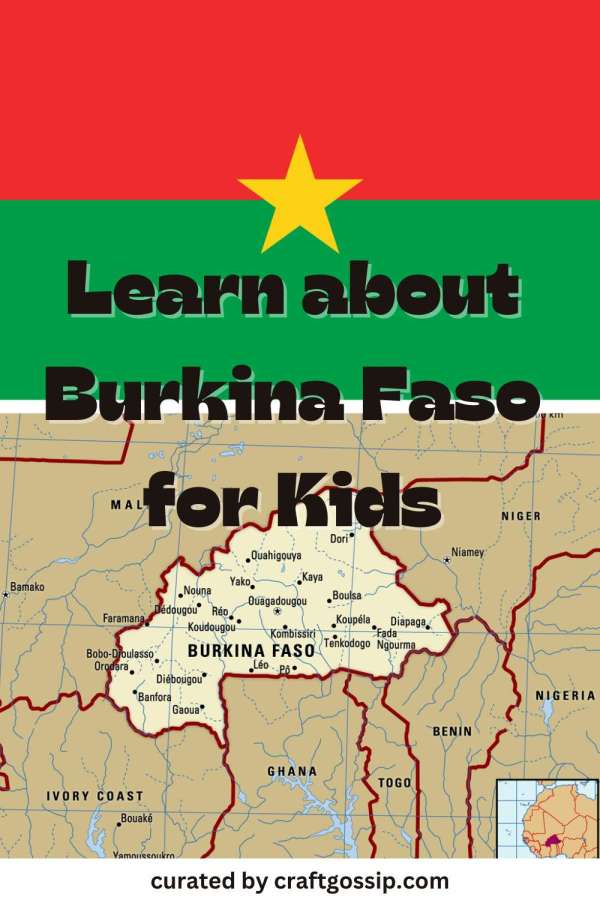
Burkina Faso is a landlocked country in western Africa that was called the Republic of Upper Volta until 1984, when it was renamed by its president, Thomas Sankara, who came to power following a coup (and was himself killed during another coup in 1987).

Burkina Faso Basics

  • The country is bordered by Mail, Niger, Benin, Togo, Ghana and Ivory Coast, and covers 105,878 square miles, or 274,223 square kilometers.
  • The nation’s capital is Ouagadougou, which is very fun to say. It’s also the largest city. About 22.5 million people live in Burkina Faso
  • The Mossi is the largest ethnic group in the country, which originally settled in the area in the 11th and 13th centuries.
  • The government recognizes 60 indigenous languages, as well as the four official languages, Mooré, Bissa, Dyula and Fula. French and English are considered “working” languages primarily used for government and business.
  • Burkina Faso is a republic but it is run by a group of military leaders. The nation’s history has been marked by a series of coups and uprisings since its independence from France in 1960.
  • The word Burkina comes from the Mooré language and means upright, while Faso is a Dioula word that means fatherland or father’s house. The CIA translates the name as land of honest men. People from Burkina Faso are called Burkinabé, a Fula word that means men or women.
  • It ranked 65 out of 78 countries for food insecurity in 2013.
  • In 2017 a 33-megawatt solar plant opened near Ouagadougou, which at the time was the largest solar power facility in West Africa.

Burkina Faso National Symbols

The flag of Burkina Faso is red at the top and green at the bottom, with a gold five-pointed star in the center. The colors are the Pan African colors, which shows unity with other nations in Africa. Red also symbolizes revolution, while green stands for the natural riches of the country. The star is said to represent the guiding light of revolution. It was adopted after the 1983 coup.

The national anthem is “Ditanye” or “L’Hymne de la vicroire” (anthem of victory) also sometimes called “Une Seule Nuit” or “One Single Night.” It was written by president Sankara, who was also a jazz guitarist.

White stallions are the national animal, and the shea tree is the national tree. We’ll get to the national dish below, but it is riz gras, or fat rice.

Burkina Faso Activities for Kids

You can find some activities and more information for kids to learn about Burkina Faso on Teachers Pay Teachers.

Try riz gris (sort of like a Spanish rice) with this recipe from Polka Dot Passport. Learn more about Burkinabé food and the popular drink with the fun name zoom koom, at 196 Flavors.

Learn more about shea butter and different ways to use it from Treehugger. You can even make your own shea butter lotion with this easy recipe from Live Simply.

Check out the stunning Ouagadougou Cathedral and the Monuments des Martyrs, two of the main landmarks in the country.
Next Plan Idea:

  • Learning about Benin for Kids
«
»

Have you read?

Book Review: Wild Your World

Most kids go through a phase where they want to learn more about animals, and it’s fun for them to learn about the diversity of the natural world and what humans can do to protect other creatures we share the planet with. Camilla de la Bedoyere has written a couple of books, illustrated by Philip Giordano, to help kids learn more about birds and bees. 

Wild Your World: Birds looks at many different kinds of birds that live around the world and covers things like parts of a bird, different habitats that birds live in, migration, camouflage, what and how birds eat and more. 

With lovely illustrations showing a diverse array of birds found around the world, the book talks about different birds that live in the woodlands, rainforest, fields and farms, coastland, grasslands and deserts, urban areas and the polar regions. 

It talks about some of the biggest, smallest and fastest birds, and fun facts about different birds. For example you’ll learn about birds that next in cacti, the birds with weird shaped eggs so they won’t roll off cliffs, and meet the birds that migrate from New Zealand to Alaska. 

Wild Your World: Bees follows a similar format, talking about different kinds of bees (and how the vast majority of bee species are solitary bees), parts of a bee and why bees look the way they do, how bees collect nectar and pollen, how bees sense the world around them, how their wings work and what life in a colony is like. 

It covers the bee life cycle, how bees make honey, what causes a swarm and more. It covers digger bees, carpenter bees, orchid bees, cuckoo bees (who lay their eggs in the nests of teddy bear bees so they don’t have to take care of their young), mining bees, plasterer bees, leaf-cutter, wool carder and mason bees (so named because they collect materials to make their nests), bumblebees and swaet bees.

Readers will also learn about keeping bees. Both books talk about the dangers to birds and bees and what humans can do to help them. 

These books are aimed at readers ages 4-9 who will enjoy looking at the pictures and learning about these animals and how people can help protect them. 

About the books: Both books are 46 pages and hardcover. Published 2025 by Design Eye (see: birds|bees). Both books retail for $16.99. 

Let’s Get Buzzing About World Bee Day

Bee Craft – Learning about Pollination

Learning about Bees for Kids

Leave a Reply

Your email address will not be published. Required fields are marked *

Categories

Art Christmas Classroom Craft by Holiday Craft Inspirations DIY Tutorials and Patterns Elementary Games General Homeschool Kids Crafts Lesson Plan Activities & Ideas Math Nature PreSchool Printables Science Craft STEM & STEAM Toddler Tween

RSS More Articles

  • Book Review: Better Homes and Gardens Flea Market Decorating
  • DIY Backyard Water Play Ideas To Keep Kids Cool All Summer
  • Book Review Wednesday: The Complete Guide to Trinket Dishes for Beginners
  • How to Embroider on Canvas Shoes for a Custom Look
  • 12 Unique Borders for Scrapbook Layouts
  • Book Review: Wild Your World
  • Knit a Stunning Bestiary Scarf
  • Quick Quilting Projects for the 4th of July
  • Samplers to Cross Stitch for the Fourth of July
  • DIY Flag Banner for 4th of July Decorating

Pick Your Blog

  • Sewing
  • Knitting
  • Quilting
  • Crochet
  • Home & Garden
  • Recycled Crafts
  • Scrapbooking
  • Card Making
  • Polymer Clay
  • Cross-Stitch
  • Edible Crafts
  • Felting
  • Glass Art
  • Indie Crafts
  • Kids Crafts
  • Jewelry Making
  • Lesson Plans
  • Needlework
  • Bath & Body
  • Party Ideas
  • Candle Making
  • DIY Weddings
  • Not Craft
  • Free Craft Projects

Copyright © 2026 · CraftGossip | Start Here | Contact Us | Link to Us | Your Editors | Privacy and affiliate policy