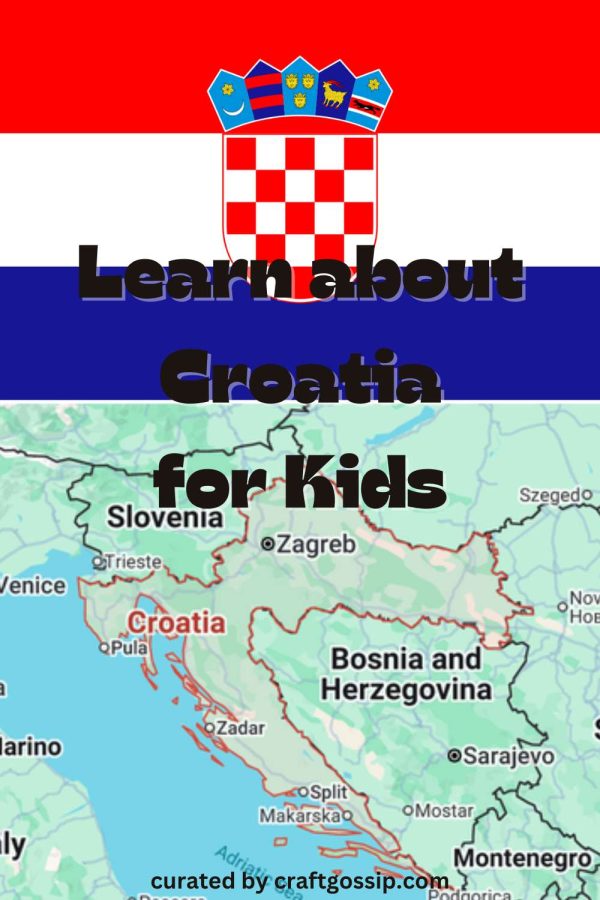
 Croatia is a country in southeastern Europe that was formerly part of Yugoslavia. It’s bordered by Slovenia, Hungary, Serbia, Bosnia and Herzegovina and Montengro, as well as the Adriatic Sea.
Croatia Basics
Croatia measures 21,851 square miles, or 6,594 square kilometers, and is home to around 4 million people.
The capital and largest city is Zagreb.
Croatia was part of the Hapsburg Empire until it became part of an independent state of Slovenes, Croats and Serbs in 1918, which became part of the kingdom of Yugoslavia later that year. It declared independence in 1991 and fought a four year war to gain its freedom.
It is a democratic republic with a parliament, president and prime minister. The official language is Croatian, and nearly 92 percent of the country’s population is ethnically Croat.
Tourism is a major industry and the landscape includes mountains, plains and the coastal region.
You may remember that when we talked about Bosnia Herzegovina we noted that only one town in the country has access to the sea. There’s a short strip of land where the town of Neum is, with parts of Croatia on both sides. The Pelješac Bridge connects the parts of Croatia on either side.
There are more than 1,000 islands and islets that are part of Croatia, including 48 that are permanently inhabited.
Here’s a fun fact for you: the first necktie was a cravat worn by Croatian mercenaries hired by Louis XIII to fight in France in the 17th century. From there it became a part of the Croatian military uniform and eventually because fashionable in France for non-soliders.
Croatia National Symbols
The flag of Croatia features red, white and blue horizontal stripes, with the coat of arms in the center. The colors combine those used in the flags of the Kingdom of Croatia (red and white) and the Kingdom of Slavonia (blue and white).
The coat of arms includes a red and white checkerboard pattern on a shield and a crown with small images showing historic coats of arms of different regions of the country. The flag was adopted in 1990.
The checkerboard itself is considered a national symbol as it is found in some medieval churches in the country. Legend has it a Croatian king once played the Doge of Venice in chess for his freedom and incorporated the design into his coat of arms to commemorate his victory. The design has been used in the coat of arms of the Croat kingdom at least as far back as 1495.
The national anthem is “Lijepa naša domovino” or “Our Beautiful Homeland.” The original lyrics were published in 1835, with music composed in 1846. It was used as the state anthem in unofficial capacities for years, and parts of the anthem were used in the anthem of the Kingdom of Yugoslavia from 1918 to 1941. It was officially adopted in 1972.
Croatia is a majority Catholic country, and many cities have their own patron saint. The patron saint of Croatia as a whole is Saint Joseph, who has been considered the patron of the region since 1687.
The national flow is Iris crocatica, a bearded iris special that’s native to Croatia. The flowers are said to bloom where the Slavic god Perun’s lightning hits the ground, and they’re a protected species so they shouldn’t be picked.
The national animal is the European pine marten, a member of the weasel family found in most of Europe.
The Slavonian oak is the national tree. These trees are slow growing and traditionally used to make oak barrels for wine storage, as well as furniture and floors.
Croatian interlace is a particular ornamentation used in building and monuments in Croatian art and found on churches and monasteries in particular built between the 9th and 12th centuries.
Croatia Activities for Kids
Learn more about Croatia from National Geographic Kids. Case of Adventure has a free Croatia printables pack that includes things like a map, flags, fun facts, coloring pages, recipe cards and more.
Find country studies and more for kids of all ages (including information about the wars of the 1990s) at Teachers Pay Teachers.
Gingerbread is considered an intangible cultural heritage of Croatia that is recognized by the United Nations. They’ve been making gingerbread there since the Middle Ages and it is a true craft where gingerbread is made in intricately formed designs. The licitar heart is probably the most well known version that you’d find in bakeries and tourist shops. You can find a recipe at Chasing the Donkey (the recipe is from the Zagreb Tourist Board).
The page about Croatian interlace linked above has drawings you can print out and use as coloring pages.
Take a peek at old town Dubrovnik, a UNESCO World Heritage site that’s a well preserved Medieval town on the Adriatic coast.
Learn about the traditional folk clothing of Croatia and listen to some traditional Croatian music. And learn to tie a tie!




Leave a Reply