 I guess mushrooms aren’t strictly a fall thing (the prized wild mushrooms where I live come out in the spring) but I think of them as a fall motif so let’s learn about mushrooms today.
Mushrooms are fungi, and there are more than 10,000 known species, ranging from delicious to deadly and coming in a multitude of shapes, sizes and colors. About 30 species glow in the dark. And they all start from a tiny spore!
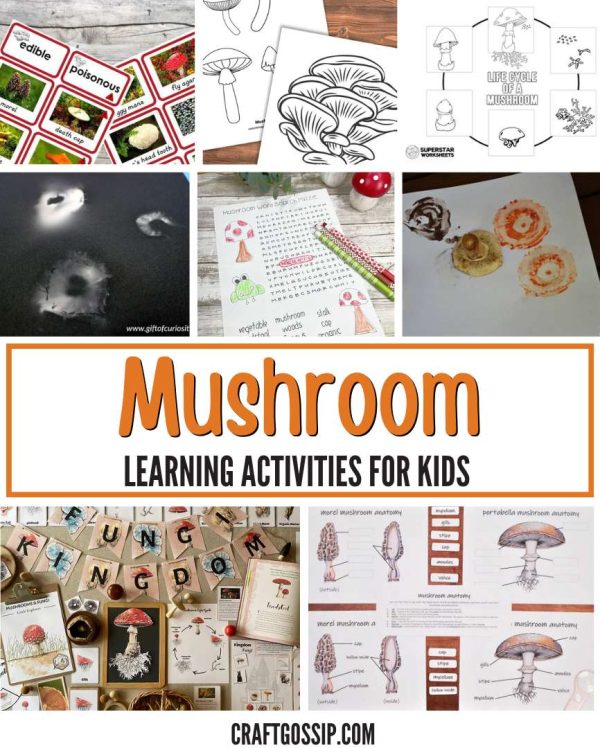
Superstar Worksheets has worksheets and coloring pages on the life cycle of a mushroom and mushroom parts. Learn more about the parts of a mushroom and get some pretty diagrams to label from Wild Earth Lab.
Montessori Nature has a free printable chart comparing edible and poisonous mushrooms. The accompanying blog post talks about the different kinds of mushrooms shown on the chart and also includes a mushroom craft and a recipe for mushrooms. They also have paid content related to mushrooms.
This one also isn’t free but the unit study from For the Love of Homeschooling is gorgeous, with all sorts of beautiful illustrations of mushrooms and fungi. You’ll learn about taxonomy, anatomy, life cycle, symbiotic relationships, foraging, medicinal uses for fungi and lots more.
Grab mushroom activity sheets including a word search, labeling the parts of a mushroom and different kinds of mushrooms, from the Cascade Mycological Society. Nature Inspired Learning also has some great realistic mushroom coloring pages. Find a cute word search and coloring page, as well as mushroom craft ideas, at Me and My Inklings.
If you teach Spanish or just want to add a little Spanish to your learning about mushrooms, Niños and Nature has some great Spanish language mushroom content.
Of course you can bring real mushrooms into your lessons about mushrooms. You can observe different varieties (or even cook with them), paint with them (or make stamps like Mother Natured did) or take prints of the spores, as in this project from Gift of Curiosity. Spore prints are also part of this mushroom dissection activity from Wild Earth Lab.
If you live somewhere with mushrooms and fungi, you can go on a nature walk and see what you find. Make sure you grab a mushroom field guide, which is fun to look at even if you can’t see mushrooms in the wild in person.
Leave a Reply