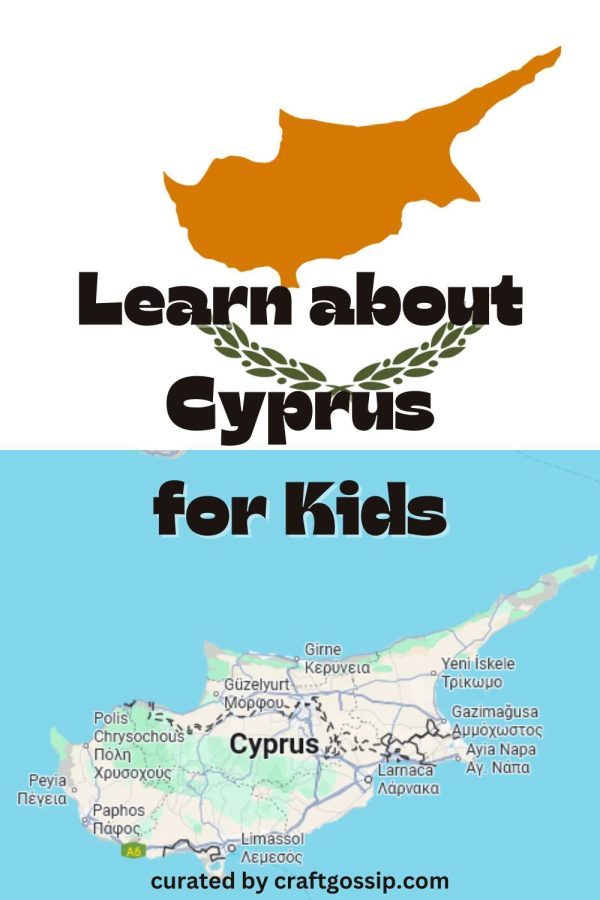
 Cyprus is an island country in the Mediterranean Sea that’s officially the Republic of Cyprus. It’s considered part of West Asia, but is more culturally associated with Southeastern Europe. Let’s learn more about Cyprus!
Cyprus Basics
Cyprus is the third largest and third most populous island in the Mediterranean. It measures 3,572 square miles (9,251 square kilometers), which is a little more than half the size of Connecticut. It has a population of about 1.3 million, the vast majority of whom are ethnically Greek.
The official languages are Greek and Turkish. The largest city and capital is Nicosia.
Its closest neighbors are Greece and Turkey, as well as Palestine and Israel, and Egypt.
It is thought that the name of the country comes from the Greek word for either the cypress or henna tree, or possibly a word for copper or bronze. The island has large deposits of copper.
The island has been occupied by many world powers over the years, and in 1878 it was placed under British administration. It was formally annexed by the UK in 1914, and was granted independence in 1960, though the British still have military bases on the island.
In 1974, a coup was mounted by the Greek Cypriots, which was followed by a Turkish invasion of the island. Ultimately a separate Turkish Cypriot state was established in the north, but Turkey is the only nation that recognizes it and there are still disputes among Greek and Turkish Cypriots.
Cyprus is a representative democracy with a president and a house of representatives, and it is a member of the European Union.
Tourism is a main industry, as well as food and beverage processing, including olives and grapes. They also produce a lot of sheep milk, pork and goat milk.
It’s one of only three nations in the EU where cars drive on the left, a remnant of British rule of the island.
Cyprus National Symbols
The Cyprus flag has a white background, with an image of the island in copper and two olive branches below. The flag was designed by a Turkish Cypriot artist and was meant to symbolize the peace and connection between the Greek and Turkish communities on the island. It deliberately did not use blue or red as those are the dominant colors in the Greek and Turkish flags, respectively.
The country’s coat of arms also features a dove and olive branches, and the dove is considered a national symbol for this reason.
The national anthem, known in English as “Hymn to Liberty” or “Hymn to Freedom,” is based on a poem written in 1823 and set to music in 1828. The portion used as the national anthem was officially approved in 1966.
The Cypriot mouflon, a wild sheep, is considered the national animal. The sheep is endemic to the island and, while it’s the largest land mammal there, it’s also smaller than the mouflon found in Armenia, an example of what’s known as island dwarfism.
I saw some sources that said cyclamen is the national flower. There are a couple of varieties of this flower that grow on Cyprus.
Cyprus Activities for Kids
Color the Cyprian flag with this printable from Flag Lane. Muse Printables has a printable maze in the shape of the island.
Check out Cyprus facts and worksheets from KidsKonnect and Activity Village, and the resources at Teachers Pay Teachers.
Ll By Eliana has a cute “travel journal” for learning about Cyprus available on Etsy. I also like the country study from Picmaster Studio.
Adventures in Mommydom has a free Cyprus unit study including good videos to watch and a recipe for Cyprian almond shortbread.
Learn more about Pafos, a city that used to be the capital of Cyprus and is considered the birthplace of Aphrodite. The entire old city is a UNESCO World Heritage Site.
Learn a little Greek with this video from Miss Jessica’s World.
Many Greek dishes can be considered national delicacies of Cyprus, which does not have an official national dish. Some suggest fasolada, a bean and vegetable soup, which is a classic Greek comfort food. Here’s a recipe from Katerina’s Kouzina. Other popular dishes are souvla (grilled meat on skewers), kleftiko (roasted lamb and potatoes) and trachanas (a mix of fermented grain and yogurt or milk that is dried).





Leave a Reply