Have you tried the writing claw? What do you think? Is this the new way to get children to hold their pencil correctly or just another do-dad for the parent to buy? My children both hold their pencils – I wont say incorrectly but different than they are meant to hold them (according to the teacher). I think as long as there is no wrist pain and the writing is correct and controlled then each child is entitled to their own style. What do you think?
Comments
Have you read?
Learning Activities with Snap Cubes
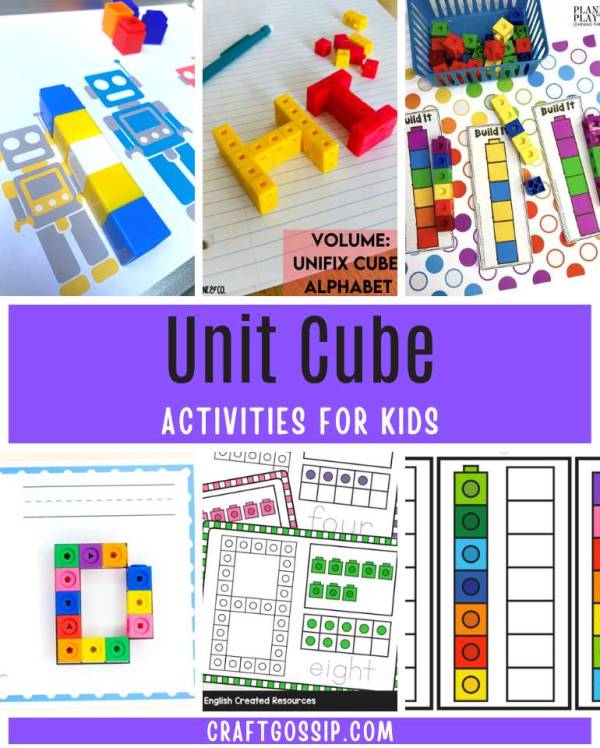
A classic manipulative in the preschool and early elementary classroom is the snap cube, also known as math cubes, unifix cubes or unit cubes. These little one inch cubes often come in a set of 100 in 10 different colors, and they snap together so they’re easy to use for all sorts of math learning, measuring and more.
No Time for Flashcards has a cute robot printable to use with cubes to measure the height of each robot. That one is free but they also have other printable cube mats that are a paid resource.
Catherine & Co uses math cubes to teach kids about measuring volume. They make a letter from cubes and then measure the volume (there’s a printable worksheet in the post).
Pattern recognition is another fun and easy activity you can do with the cubes. You can use printables like these from Planning Playtime, or just make a pattern from cubes and have kids repeat it or figure out what comes next. There’s another good set of pattern printables at English Created Resources.
Because there are 10 sets of 10 cubes in a pack, these are great for teaching one to one correspondence, counting, sorting and basic addition and subtraction. English Created Resources has great printable number mats you can use to form the number from cubes and count out the number of cubes that corresponds to that number.
ParenTutor has a great collection of snap cube activity ideas, most of which are just pictures, but it’s work taking a look through the post for ideas for using them at home or in the classroom.
To give just a few of their examples, you can match linked blocks to the corresponding number of pieces, use blocks to find different ways to add up to 10, compare numbers and determine which one is more or less, skip counting and weighing different numbers of blocks.
You can also use unit cubes to learn letters, like with these super cute alphabet mats from Fun Learning for Kids. Kids can trace the letter, make it out of cubes and practice writing a word that starts with that letter.
Of course you can also use them to build things, since they are blocks, and there are tons of pattern mats on Teachers Pay Teachers. I also love these dinosaur themed mats from Lets Go to Learn on Etsy.

Actually, I think that the supposed ‘correct’ way to hold a pencil may contribute to carpal tunnel syndrome, and I refuse to hold my pencil that way. In fact, I CAN’T hold it that way even long enough to sign my name, any more, without my CPS flaring up – so nope – I don’t think kids should be forced to hold their pencil any specific way.
They need to find a way to hold it, that doesn’t hurt their fingers or wrist, that still gives the writing result required. I don’t see anything wrong with teaching them the traditional hold – but if it doesn’t work for them, then we need to find a way that suits their hands better. This reminds me of the old tradition of tying a left-handed kid’s left hand behind his/her back, and forcing them to write right handed. What is natural for one isn’t necessarily natural for the next.
Definitely a doodad aimed to get parents separated from their money. I don’t hold my pencil/pen the way the device shows and I have most excellent handwriting!